Nearly 10 Million Elden Ring Players Have Passed 100 Hours, Analyst Estimates

Alinea's estimates put Elden Ring above 9.8 million 100-hour players, with platform achievement rates and sales figures showing different parts of its longevity.
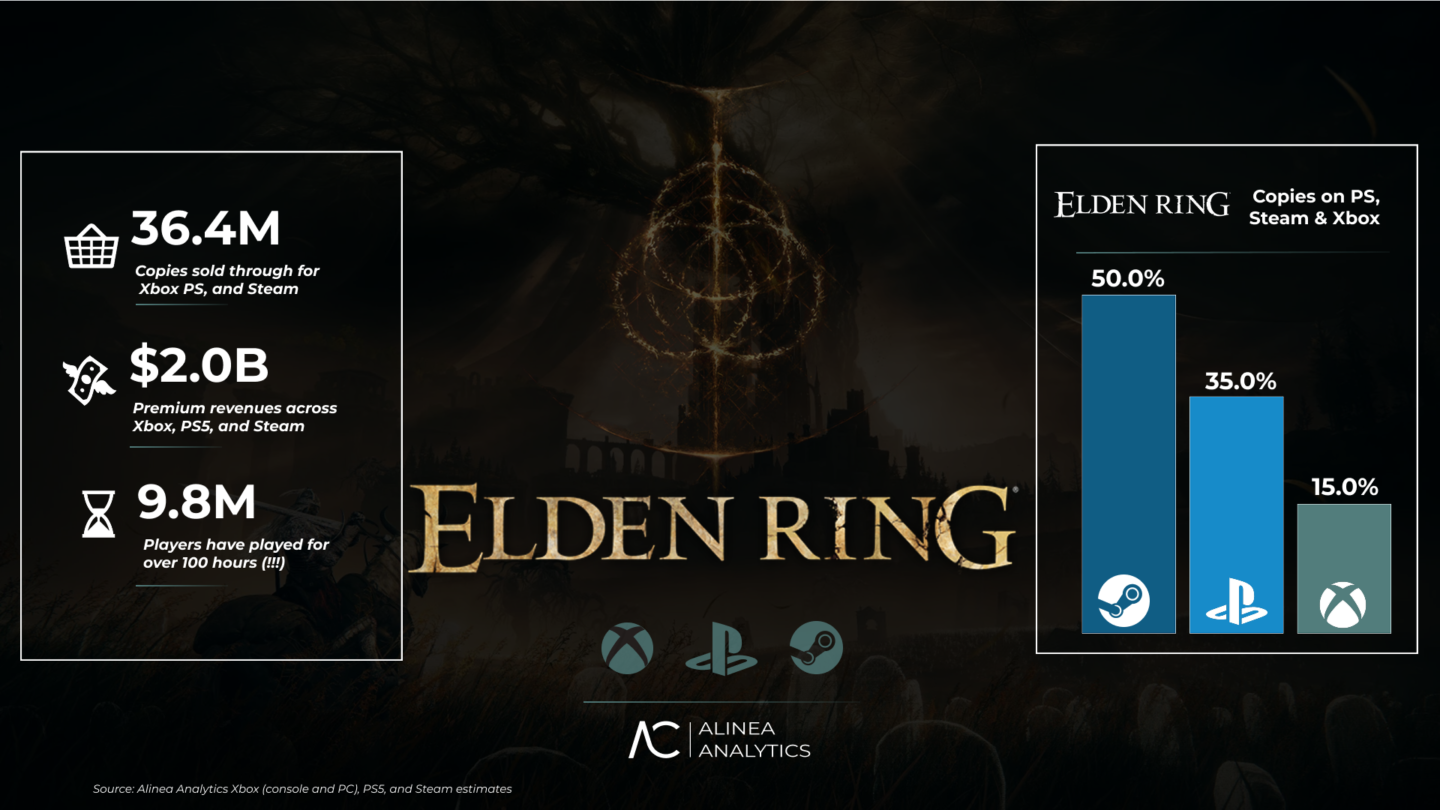
More than 9.8 million Elden Ring players have crossed 100 hours, according to Alinea Analytics. At that threshold alone, the group represents roughly 980 million hours of play, a substantial audience commitment for FromSoftware’s exploration-led RPG.
Alinea’s October 22 analysis also estimates nearly 3.5 million players have earned every base-game achievement and puts sales at 36.4 million copies across the platforms it analyzed. The numbers are market estimates rather than publisher-reported totals.
Playtime, achievements and sales
| Metric | Reported Figure | Scope |
|---|---|---|
| Over 9.8 million above 100 hours | A cumulative playtime threshold | Daily activity, campaign completion, or enjoyment. |
| Nearly 3.5 million with every achievement | Completion of the tracked list | Every optional discovery or expansion challenge. |
| 36.4 million copies | Estimated sales across the analyzed platforms | An identical number of unique active people. |
What the 100-hour milestone captures
Multiplying the rounded 9.8 million estimate by the 100-hour threshold gives about 980 million hours. Actual accumulated playtime would be higher: these players have passed the threshold, and the calculation excludes everyone below it. It is a lower-bound illustration based on Alinea’s estimate.
The 100-hour figure is equivalent to about 26.9% of the 36.4 million copies estimate. That comparison uses two different populations, players and purchases, so it cannot provide a measured retention rate.
Completion rates vary by platform
Alinea gives full-list completion rates of 10.9% on PlayStation, 10.5% on Steam, and 3.9% on Xbox. Those rates cover different player populations and achievement systems; they are best read as platform-specific completion figures.
The publisher’s Steam description emphasizes exploration and varied character builds. Both give players ways to extend a save beyond its tracked objectives: returning with a different build or exploring a missed route can add hours without another achievement.
The official Shadow of the Erdtree description also matters here: it identifies an expansion that requires the base game. Time spent returning to an existing installation for more content can contribute to a playtime total without representing another base-game purchase. The estimate does not break the 100-hour group into base-game-only and expansion players.
Elden Ring’s open world accommodates very different uses of an evening: learning a boss, helping another player, revisiting a region or building a new character. The same playtime threshold can include all of them, which helps explain why achievement completion and hours played diverge.
Revenue reflects where and how people buy
Alinea also estimates around $2 billion in revenue. Consoles supplied 57.5% of that total while representing roughly half the copies in its analysis. The analyst points to regional pricing and the geographical mix of PC purchases as explanations for the difference.
A simple revenue-per-copy division would average across that mix. It would not identify the price any one buyer paid, the share retained by the developer, or profit after costs. A full-price purchase in one market and a discounted purchase in another can contribute equally to unit sales while contributing different amounts to spending.